Tools & repairs · RESEARCH-BASED GUIDE
Fluke 1AC II VoltAlert: a first check, not an all-clear
Decide whether this 90–1000 V AC non-contact detector fits your task, and understand why a silent tip cannot prove a circuit is safe.
Affiliate disclosure: As an Amazon Associate I earn from qualifying purchases. We may earn a commission from qualifying purchases through links marked “Affiliate link”, at no additional cost to you. Read our disclosure.
Based on linked manufacturer information and our editorial decision framework. We have not personally tested the featured products. How we work.
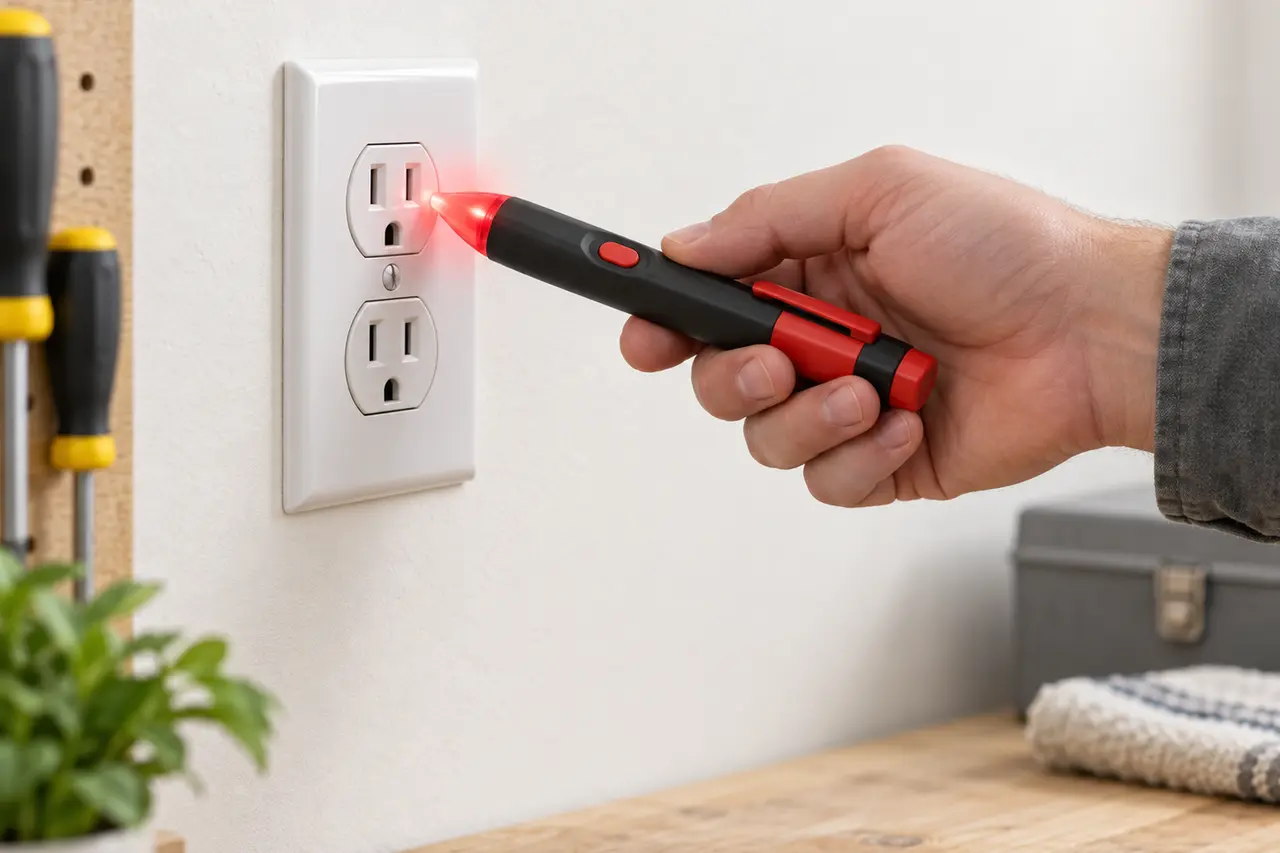
At a glance: fit, benefit and alternatives
| Decision | Our assessment |
|---|---|
| Who it suits | Competent users who need a quick preliminary indication of common mains AC voltage and will follow it with the correct safety procedure and test instrument. |
| Why consider it | A pocketable first check for sensing a sufficiently strong AC electric field near an outlet, cord or accessible conductor without touching bare metal. |
| The trade-off | A negative indication does not prove a circuit is de-energized. It does not replace a voltmeter or two-pole detector for confirming the absence of hazardous voltage. |
| Choose something else when… | Choose a suitable voltmeter or two-pole voltage detector when you must prove the absence of hazardous voltage. Compare a lower-range or dual-range detector for control circuits; call a qualified electrician when the task exceeds your training. |
Start with the question you need answered
A non-contact detector can help answer a narrow first question: is there a sufficiently strong AC electric field near this accessible point? It cannot answer every electrical safety question. Fluke's instruction sheet explicitly says this single-pole detector is not suitable for deciding whether a circuit is hazardous and requires a voltmeter or two-pole detector to confirm the absence of hazardous voltage before work begins. That boundary is the main buying decision, not an optional footnote.
What the exact A1 model establishes
The Fluke-1AC-A1-II, part 2432932, is the North and South America/Asia version with a nominal 90–1000 V AC detection range. Fluke specifies a red illuminated tip, an optional continual beep, a periodic VoltBeat self-test flash, automatic power-off, two AAA alkaline batteries and a CAT IV 1000 V rating. The similarly named European and low-voltage models have different ranges, so the model suffix matters.
Match the tool to the job
| What you want to know | Better decision |
|---|---|
| A quick preliminary indication near a typical mains outlet or cord | The 1AC-A1-II is worth comparing |
| Whether a circuit is proven de-energized before work | Use the required voltmeter or two-pole detector and safety procedure |
| Whether low-voltage controls are energized | Compare a detector whose stated range covers that system |
| Diagnosing DC, wiring condition or voltage value | Choose an instrument designed for that measurement |
The useful routine is live–test–live
Fluke instructs users to test the detector on a known live source within its rated range before and after use, and not to use it if the VoltBeat indicator is not flashing. Keep your hand behind the tactile barrier and inspect the tip for damage. A missing indication can result from shielded cable, insulation, distance, socket design, weak field strength, user isolation, battery condition or tester condition. The second known-live check matters because a detector can fail during the job.
How it compares without inventing a winner
Bob Vila's hands-on comparison selected the 1AC II as its overall pick, praising its pocket fit, self-test indication and quick audible/visual alert while noting that switching between audible and silent modes takes practice. That independent result supports usability, not universal suitability. A lower-priced detector may be enough if its verified range, safety rating and operating checks match your task; a dual-range model may be more useful for lower-voltage systems. A contact meter or two-pole tester answers a different and more demanding safety question.
When not to buy it
Do not buy this model if you expect a no-light result to authorize electrical work, if your system sits below its 90 V AC lower range, if you need DC or numeric measurements, or if you are not trained for the planned task. Keep a serviceable detector you already own when its verified range and safety category fit the same job and it passes the required checks. For uncertain household wiring or exposed live conductors, stop and use a qualified electrician rather than adding a tester to the cart.
Listing and commercial limits
The Amazon.com listing checked on 16 September 2026 identified ASIN B000EJ332O as the Fluke 1AC II in the 1AC-A1-II 90–1000 V variation. It showed no featured offer at the time of checking, although other sellers were presented; price, stock, seller and delivery are therefore not promised here. Amazon Associates eligibility and the commission rate for a resulting order were not independently confirmed for this item and remain unknown.
Other finds for the same task
Consider these only if they solve another part of your task.
- KNIPEX Cobra XS — For a compact maintenance kit, compare a separate mechanical gripping tool only when the task calls for it; pliers do not test electricity.
Sources & scope
Sources checked on 16 September 2026. Product facts come from the pages below; selection tables and suggested checks are our editorial analysis, not test results.
- Fluke 1AC II product specifications (opens in a new tab)
- Fluke 1AC II instruction sheet and safety limits (opens in a new tab)
- Bob Vila: independently tested voltage tester comparison (opens in a new tab)
- Amazon.com listing for ASIN B000EJ332O (opens in a new tab)
Found a factual error or a changed listing? Send a correction with the page address and supporting source.